

Rio de Janeiro Carnival: What to expect and how to know if it’s worth it for you




Rio Carnival is sold to the world as a spectacle. And it is one indeed, but that's only half the story.
What no one tells you before you book the flight: Carnival isn't for everyone. You can either fall completely in love with it, or count down the days until it's over. The difference usually comes down to what you expect from Carnival in Rio de Janeiro.
This guide is the honest version of what Rio Carnival actually feels like on the ground, the different layers, how safe it really is, and how it all works, so you can decide if Rio de Janeiro Carnival is worth it, or if Rio might suit you better at a different pace.
In this guide
- 1When is Rio Carnival and what is it like?
- 2What kind of Rio Carnival experience do you want?
- 3Do you need tickets for Rio Carnival?
- 4Is Rio Carnival dangerous?
- 5Carnival in Rio de Janeiro as a solo traveler
- 6How to get to Rio de Janeiro for Carnival
- 7Where to stay in Rio de Janeiro during Carnival
- 8How long should you stay for Rio Carnival?
- 9Getting around Rio during Carnival
- 10So, is Carnival in Rio de Janeiro worth it?
When is Rio Carnival and what is it like?
First, the basics: what Carnival in Rio de Janeiro actually is, and when it happens.
Carnival in Brazil doesn’t have fixed dates. It changes every year, usually taking place in February or March, depending on the Easter calendar. Officially, it lasts five days (from Saturday through Ash Wednesday).
In reality, it takes over the entire week and the build-up begins as early as the first week of January.
Planning for a specific year? Check our Rio Carnival 2027 dates and tickets guide with exact dates and how to book your tickets.
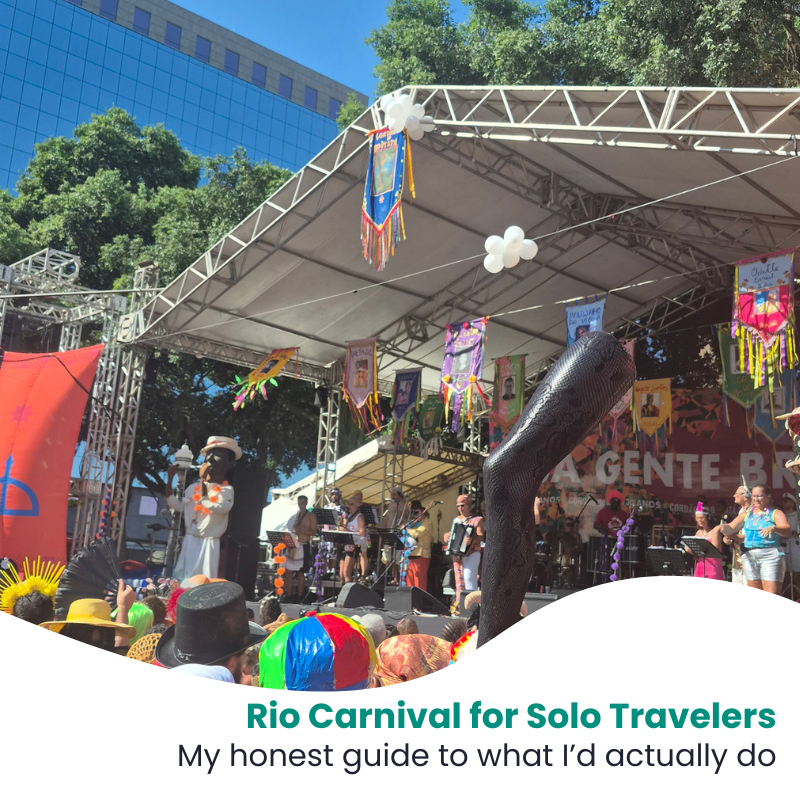
At its core, Carnival is a massive cultural celebration that takes over the entire city. While many people picture the iconic Sambadrome samba parades, most of the experience actually happens in the streets, through hundreds of free parties known as blocos.
Some travelers come for the spectacle of the samba schools. Others come for the energy of the street parties. Most end up experiencing a mix of both.

Ipanema beach packed with crowds during Rio Carnival. Photo: luoman
What kind of Rio Carnival experience do you want?
Carnival in Rio de Janeiro isn't one experience, it plays out very differently depending on where you go and how you want to feel it. In Brazil, a Carnival reveler is called a folião, and not every folião wants the same thing. Figuring out which one you are makes planning the rest of your trip much easier.
The comfortable, air-conditioned way to experience Carnival

For the traveler who wants the spectacle without the sweat, the queues, or the crowd density.
Sambadrome Camarotes (VIP boxes):
The premium way to attend the Carnival parade in VIP style. The VIP boxes are enclosed sections with open bar, buffet dining, private security, and air conditioning. Many include door-to-door transfers, so you skip the crowds outside entirely.
See our complete guide to Rio Carnival 2027 tickets for prices and how to book.
Hotel feijoadas:
Daytime, ticketed events hosted by several 5-star hotels with traditional food, caipirinhas, and live samba in a comfortable, organized setting.
Ticketed bloco rehearsals and parties:
Want the energy of a bloco without the open street? Venues like Fundição Progresso in Lapa host structured, ticketed rehearsals with brass, percussion, and a crowd that knows every chorus, all indoors with real infrastructure.
Private balls and parties:
Black-tie or elaborate fantasy events like the Baile do Copa at Copacabana Palace. The place to see and be seen.
Curious about this whole layer of Carnival beyond the parade and the blocos? We cover it in detail in this guide, from rooftop parties at Sugarloaf to the Baile do Copa.
The budget, high-energy way to experience Carnival


For the folião raiz — the reveler who wants to feel the asphalt shake.
Blocos de rua (Carnival street parties):
The democratic heart of Carnival, and where most locals actually celebrate. Around 450 blocos are officially registered in Rio each year, nearly 300 of them during Carnival week alone, including about 10 massive megablocos that draw crowds in the hundreds of thousands.
Free, no tickets, no fences, just a sound truck or brass band and thousands of people following the music through the streets.
Check the complete guide to Rio Carnival blocos for a deep dive.
Grandstands (Arquibancadas):
The concrete bleachers of the Sambadrome. No buffet, no A/C but this is where the real community sits, surrounded by locals who know every word of the samba enredo.
Read the Sambadrome first-timer guide for more details.
What kind of Carnival is right for you?
You don't have to pick one and stay there. That's the beauty of Rio Carnival, it's genuinely democratic.
Once you know what to do, see exactly what it costs in our Carnival budget breakdown.
Do you need tickets for Rio Carnival?
One of the most confusing things about Rio Carnival is whether you actually need tickets. Here’s a quick breakdown:
Sambadrome (parades) → tickets required, sales start months in advance
Blocos (street parties) → free, no tickets needed
Parties and special events → usually ticketed, with sales starting closer to the event
If you want to attend the samba school parades, you’ll need to buy tickets in advance since sales start months before the event.
See our full guide to Rio Carnival 2027 tickets, including where to buy and how to choose the best seats.
Is Rio Carnival dangerous?
No, not in the way headlines make it sound. It's intense: millions of people, packed streets, and a level of alertness you wouldn't need on a normal day in Rio de Janeiro.
But it isn't chaos without structure. The usual precautions go a long way, and most visitors get through Carnival without any issue.
What changes during Carnival regarding safety
Security is reinforced across the city during Carnival.
At major blocos, especially the megablocos in Downtown, it’s common to go through police checks before entering certain areas. The same applies to the Sambadrome, where access is controlled and organized.
Public transport, especially the metro, also operates with increased monitoring and security presence.
Choosing a safer Rio Carnival experience
The type of Carnival you choose affects how much you need to think about safety. Structured options like camarotes with organized transport, private parties, ticketed events, mean controlled entry, security, and a predictable setting from door to door.
Blocos, on the other hand, are open and dynamic: safe for most people, but they ask for more attention, especially in bigger crowds. Neither is "the safe one" and "the risky one", it's a trade-off between comfort and spontaneity, and it comes back to what kind of Carnival experience fits you.
Safety at Carnival blocos
Blocos are open, crowded, and dynamic and safe for most people, but they ask for more street awareness than a normal day in Rio.
Our complete guide to Rio Carnival blocos has the full safety rundown, from choosing the right size bloco to protecting your phone and drink in a crowd.
One small tip for safety that makes a big difference
Instead of carrying documents, keep a small note in your bag with essential information such as blood type, allergies or medical conditions, emergency contact and hotel name and neighborhood.
In case of an emergency, this simple habit can save precious time.
Carnival in Rio de Janeiro as a solo traveler
Doing Carnival solo is more common than people expect, and it works. The city fills with travelers doing exactly the same thing, which makes it easier to meet people than on an ordinary trip to Rio.
Blocos are naturally social, too. You don't need to arrive with a group — just follow the music and strike up a conversation with whoever's next to you, and there's a good chance you'll spend the next hour dancing together.
Going alone? Read the complete guide to Rio Carnival as a solo traveler — safety, where to stay, and how to actually meet people.
🎭 Ready to plan the details?
Now that you know what kind of Carnival experience fits you, here's where to go deeper.
→ Sambadrome tickets and prices
Sectors, camarotes, and how to buy from abroad.
→ The complete guide to Rio Carnival blocos
Timing, safety, and the best ones by neighborhood.
→ Carnival parties and events beyond the Sambadrome
Baile do Copa, Sky Park, hotel feijoadas, and more.
→ How much a trip to Rio Carnival costs
Budgets including accommodation, tickets and food for different travel styles
How to get to Rio de Janeiro for Carnival
Planning a trip to Rio Carnival starts long before the first samba beat.
Flights to Brazil during Carnival are in high demand, and prices tend to rise quickly as the dates get closer. If you’re planning ahead, the sweet spot to book international flights is usually between 3 to 6 months in advance.
Domestic flights follow a similar pattern. If you’re coming from another city in Brazil, the best fares are often found up to 60 days before the trip.
Most international travelers arrive at Rio de Janeiro – Galeão International Airport (GIG), the city’s main international gateway. In some cases, flying into São Paulo (GRU) can be cheaper, especially from Europe or North America.
From there, you can take a short domestic flight to Rio, to GIG or SDU airports, or a 6-hours bus ride — often at a lower total cost.
Either way, getting from the airport or bus station to your hotel in Rio is relatively easy, with several options depending on your budget and arrival time. You can find a full breakdown in our guide on how to get from Rio airport or bus station to your hotel.
Where to stay in Rio de Janeiro during Carnival
Where you stay during Carnival shapes your entire experience more than at any other time of year. Streets close, neighborhoods transform, and the distance between your hotel and the nearest bloco or metro station matters in a way it simply doesn't in an ordinary week.
There is no single best area — only the one that matches the kind of Carnival you want to have. Each neighborhood offers a different trade-off between proximity, price, crowd level, and logistics.
We put together a complete guide to where to stay in Rio during Carnival with honest pros, cons, and who each area is really right for.
How long should you stay for Rio Carnival?
Officially, Carnival lasts five days: from Saturday to Ash Wednesday. But in reality, the celebrations start earlier and extend beyond those dates.
Some travelers consider staying only for the official Carnival days, focusing entirely on the peak of the celebrations.
But it’s important to remember that Carnival is a national holiday in Brazil. The city gets significantly more crowded, prices are higher, and visiting major attractions like Sugarloaf Mountain or Christ the Redeemer become more challenging during those days.
If exploring Rio de Janeiro beyond Carnival is part of your plan, it’s worth arriving a few days earlier or staying a few days after. This gives you time to enjoy the city’s main sights at a slower pace.
You’ll find the city calmer, have a better chance to explore major sights, especially if you understand what the weather is like during that time of year. You can see what Rio de Janeiro weather is really like (and how to plan your trip) in our full guide.
Getting around Rio during Carnival: How to beat the traffic
Rio's traffic rules change completely during Carnival. Hundreds of streets are closed for street parties (blocos), and gridlock is common. Here is how to navigate the city like a pro:
The Metro (Your Best Friend): This is effectively the only way to travel quickly between the South Zone (Copacabana, Ipanema) and the City Center (Sambadrome).
Learn more about Rio de Janeiro’s metro system and how to pay in this guide.
24-Hour Operation: During the main Carnival days, the Metro typically runs 24 hours a day non-stop.
Going to the Sambadrome: The subway stops right next to it. Check your ticket sector: usually, Central Station is for odd-numbered sectors, and Praça Onze is for even-numbered sectors.
Uber & Taxis: Rideshare apps work, but expect surge pricing (2x or 3x normal rates) and cancellations.
Also, because of street closures, your driver might not be able to drop you at your exact door. Be prepared to walk the last few blocks.
City Bikes: Rio has an excellent bike-sharing system (the orange "Bike Itaú" stations). Cycling along the beach path (Ciclovia) is a beautiful way to see the city in the morning.
Walking: Within neighborhoods (like moving from one bloco to another in Ipanema), walking is often faster than driving. Just wear comfortable sneakers!
So, is Carnival in Rio de Janeiro worth it?
Rio is a city defined by energy, music, and life lived outdoors — and Carnival is all of that on steroids.
But that intensity comes with trade-offs: summer heat, crowds that take over the entire city, prices that spike, and a calendar that shifts every year and requires planning months in advance.
If that's not your style, Rio is a brilliant city to visit at any other time of year. But if you go in with the right expectations — and the right plan — Carnival can genuinely be the experience of a lifetime.

Written by Karina
Born and raised in Rio de Janeiro, Karina spent over a decade working in the tourism industry, with experience in some of the world's leading travel destinations. She created Going to Rio to bring that same standard of practical, traveler-first guidance to visitors exploring Rio de Janeiro. Learn more about Karina


Three real budgets for spending Carnival in Rio, covering hotels, Sambadrome tickets, food, and sightseeing, so you know exactly what to expect no matter your travel style.