

Rio Carnival blocos: The complete guide to street parties


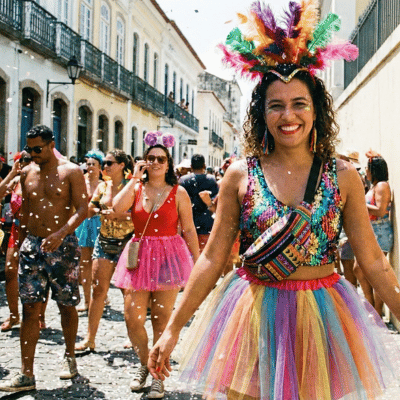
During Carnival, the Sambadrome gets the headlines. But ask any Carioca where Carnival really happens, and they'll point you to the street.
Rio's Carnival blocos are free, open-air street parties that take over entire neighborhoods during Carnival week and in the weeks before it.
No tickets, no fences, no dress code beyond creativity and color. You show up, you follow the music, and within minutes you're part of one of the most extraordinary celebrations in the world.
This guide covers everything you need to join a bloco with confidence including what they are, when to go, what to wear, and how to navigate them safely.
Already decided on Carnival? Check Rio Carnival 2027 dates and tickets for the full calendar.
What are Rio Carnival blocos?
A bloco is a street party organized around a band, a sound truck, or a brass ensemble that moves, or stays put, while a crowd follows and dances around it.
They range from a few hundred people in a quiet neighborhood to hundreds of thousands packed into the avenues of Centro.
There are three main types:
Megablocos are the largest street parties in the world. Events like Cordão da Bola Preta and Bloco da Anitta draw hundreds of thousands of people to the wide avenues of Downtown and Copacabana.
The energy is extraordinary but so is the crowd density. First-timers should go in knowing what to expect: it's less "street party" and more "city-wide event."
Moving blocos the majority of the blocos follow a set route through the streets, led by a sound truck or brass band. The crowd moves with them, filling the city with music. These are the closest thing to the classic bloco experience, they are spontaneous, joyful, and genuinely local.
Most moving blocos have an official concentration point and a published start time, but the route and endpoint are often not announced in advance. Part of the charm is not knowing exactly where the music will take you.
Some of the more intimate blocos deliberately keep their concentration point unpublished to limit the crowd size and preserve the neighborhood feel. If you want to find them, local tips and Rio Carnival community groups on social media are your best source.
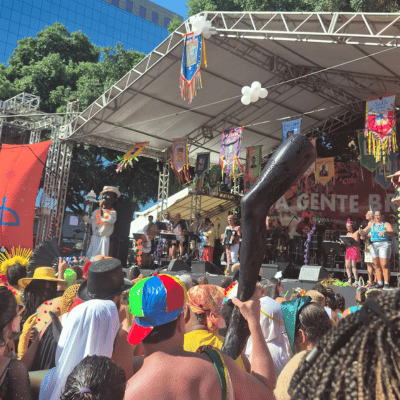
Stationary blocos are organized around a fixed stage set up in a square, park, or closed-off street. They tend to be smaller, more organized, and more family-friendly, making a good option for first-timers who want the bloco experience with more control over their surroundings. Rio has some beloved classics in this format.
Cordão do Boitatá is one of the most traditional, celebrating the roots of Rio's Carnival culture at Praça XV, Downtown. A stage set up at the Leme end of Copacabana is another fixture, bringing live performances to one of the most scenic stretches of the neighborhood.
More recently, the Aterro do Flamengo has become a new gathering point, with traditional blocos performing on a stage near the Monumento aos Pracinhas.
How to identify a Carnival bloco
Most blocos have a distinctive visual identity. Look for the estandarte, a flag or banner carried at the front of the procession that marks the bloco's name and identity. Following the estandarte is the most reliable way to stay with the bloco as it moves through the crowd.
Street performers on stilts or roller skates (pernas de pau) are also a common sight, weaving through the crowd and adding to the spectacle. Where there are performers, the bloco is usually close by.
Rio Carnival blocos: scale, history and the most famous ones
Rio de Janeiro has more than 400 officially registered blocos, making it the largest street Carnival in the world by sheer number of events. Not all of them parade during Carnival week itself. Many of the most beloved blocos take to the streets weeks before, with an unofficial kickoff on the first Sunday of January.
If you're arriving early, you might actually catch some of the best ones. See our Pre-Carnival guide for dates and what to expect.
The tradition dates back to the mid-19th century, when anarchic groups of revelers took to the streets with little structure beyond the shared desire to celebrate. By the early 20th century, a loose organization began to take shape and Blocos emerged with a balance between order and joyful disorder.
Some blocos have been parading for over a century and have become cultural institutions as important to Rio's identity as the Sambadrome itself.
Some of the most famous blocos in Rio:
Cordão da Bola Preta — founded in 1918, it's one of the oldest and largest blocos in Rio. It parades in Centro and consistently draws over a million people. Marchinha is the soundtrack: traditional, nostalgic, and singalong from start to finish.
Monobloco — one of the most beloved contemporary blocos, known for its brass-heavy sound and multigenerational crowd. It also performs at Fundição Progresso during the pre-Carnival season in a more structured indoor format.
Simpatia é Quase Amor — a classic Ipanema bloco with a loyal following and a relaxed, neighborhood atmosphere. A great first bloco for visitors.
Sargento Pimenta — plays Beatles songs in samba and marchinha arrangements. Exactly as fun as it sounds.
Bangalafumenga — high energy, brass-driven, and one of the most musically exciting blocos in the city. Popular with locals and expats alike.
Carmelitas — the iconic Santa Teresa bloco, winding through the neighborhood's cobblestone streets with nuns in costume leading the procession. Atmospheric and unlike anything else in Rio.
Worth knowing before you go: Santa Teresa is one of the most challenging neighborhoods to navigate during Carnival. Access points are limited, streets close unpredictably, and getting in and out during peak times can be genuinely difficult. If it's your first Carnival, save Carmelitas for when you're more comfortable navigating the city.
Going to Rio Blocos App — coming January 2027
We're building a dedicated app for Rio Carnival blocos with the complete list of registered blocos, neighborhood maps, start times, crowd size estimates, and route information updated in real time.
What to expect at a Rio Carnival bloco
How long does a bloco last?
Most blocos run for three to five hours. The official start time is when the band or sound truck begins moving but the concentration point starts filling up 30 to 60 minutes before.
Plan for at least two to three hours if you want the full experience, but you can join or leave at any point. There's no entry or exit control.
What music plays at blocos?
It depends on the bloco and that variety is part of what makes Rio's Carnival unique.
Traditional blocos play marchinha, a classic, upbeat Carnival music style with brass instruments and singalong choruses that date back to the early 20th century. These are the most authentically Carioca blocos and the ones locals get most nostalgic about.
Samba blocos follow a samba school-style format with percussion-heavy, rhythmic, and energetic.
Some blocos have broader playlists mixing Brazilian pop, funk, and axé. And a few, like Monobloco, have become institutions in their own right with brass-heavy, high-energy, and beloved across generations.
If music style matters to you, look up the bloco before going because most have a strong identity and a loyal following.
When to go: timing is everything
Many blocos start as early as 7am, precisely to beat the heat offering cooler temperatures, a more comfortable experience, and the most uniquely Carioca moment you'll have: the city waking up in costume, music already filling the streets, caipirinhas in hand before breakfast.
Don't expect fewer people, though. The most popular blocos are already packed at this hour. Arriving early means being part of the crowd from the beginning, not avoiding it.
If you want a more manageable experience, mid-sized neighborhood blocos are a better choice than the megablocos regardless of what time you arrive.
The sweet spot for most blocos is the first two to three hours. As the day progresses, the crowd grows and the heat intensifies.
By early afternoon, the largest blocos can become genuinely overwhelming and by late afternoon, as the crowd starts to thin and people have been drinking for hours, the atmosphere becomes less predictable.
Rio in February is hot and humid with temperatures regularly hit 35°C (95°F) in full sun. Hydration, sunscreen, and a hat are not optional. Pace your drinking accordingly.
Are there bathrooms at blocos?
Yes, portable toilets (banheiros químicos) are provided along bloco routes, especially at the larger events. They can be hard to find in the middle of a dense crowd and the lines get long as the day progresses. Go before you need to.
Is there food and drinks?
Yes. Street vendors set up along bloco routes selling water, beer, caipirinhas, coconut water, and snacks. Cash is widely accepted and faster than cards at these vendors. Bring some small bills.
Can I buy bio-glitter and costumes on the spot?
Yes. In the days before Carnival, the streets around bloco neighborhoods fill with vendors selling costumes, accessories, and bio-glitter. You don't need to plan your costume in advance, but if you want something specific, buying earlier gives you more options.
Which Carnival blocos are right for you?
First-timer: Start with a mid-sized moving bloco in Ipanema, Leblon, or Botafogo or a stationary bloco in Downtown. The crowds are manageable, the neighborhoods are safe and live, and the experience is genuinely festive without being overwhelming. Save the megablocos for your second Carnival.
Experienced traveler: Downtown's megablocos like Cordão da Bola Preta and Monobloco are bucket-list experiences. Go early, travel light, and know your exit.
Families and quieter experience: Fixed blocos in residential neighborhoods like Laranjeiras, Cosme Velho offer the music and color with more space and a calmer crowd. Barra da Tijuca also has smaller, more family-oriented blocos.
Solo women: Blocos are welcoming spaces for solo female travelers. See our guide to Rio for solo women for specific tips on navigating Carnival alone.
How to join a Carnival bloco
Blocos are free and require no ticket. Most people simply show up and join the crowd with no advance planning required.
If you want to follow a specific bloco from the start, look up the concentration point and arrive before the published start time. Rio's streets change significantly during Carnival and closures, diversions, and crowds make navigation harder than usual, so check the route in advance and arrive on foot or by metro.
But you don't need to find the start. Some of the best spots to intercept blocos as they pass through are Largo do Machado, Aterro do Flamengo, and the area around Praça Paris, all natural gathering points where multiple blocos cross throughout the day. Pick a spot, wait for the music, and join when it arrives.
What to wear to a Rio Carnival bloco
Costume: Locals love color, glitter, and creative props. There's no wrong answer — the more creative, the better. Keep it light and breathable given the heat.
Glitter: Regular glitter is microplastic that ends up in the ocean and on the streets. Rio's bloco culture has increasingly embraced bio-glitter (biodegradable) — it's widely available in the city before Carnival and the responsible choice.
Shoes: Do not wear flip-flops to a bloco. The ground gets wet, dirty, and extremely crowded. Wear old, comfortable sneakers that you don't mind ruining — they will get stepped on, splashed, and dirtied. Closed-toe shoes also protect your feet in dense crowds.
Small crossbody bag and/or money belt: A small bag worn in front with just your phone, some cash, and a card is all you need. Leave jewelry, expensive watches, and anything you'd be upset to lose at your accommodation.

Everything you need and nothing you don't. Dress light, protect your valuables, and wear shoes you don't mind ruining.
Safety at Rio Carnival blocos
Blocos are safe but they require more awareness than most events you've attended.
Choose your bloco wisely. The experience and the risk level vary enormously by size. A neighborhood bloco in Botafogo or Flamengo is a very different environment from a megabloco in Centro with 500,000 people. First-timers are better served starting with a mid-sized bloco before graduating to the largest ones.
Keep valuables secure. Keep your phone in a front pocket or inside your crossdoby bag not in your hand unless you're actively using it.
Watch your drink. Stick to sealed cans or bottles from official vendors. Avoid accepting open drinks from strangers.
Stay oriented. Agree on a meeting point with your group before entering the crowd, mobile signal can be unreliable in very dense areas. Know your exit route before you need it.
For more detailed safety guidance, see our complete safety guide for Rio de Janeiro.
A note on conduct
Blocos are inclusive, joyful spaces and keeping them that way is everyone's responsibility.
"Não é Não" (No means No): Minimal clothing is part of the celebration and the culture and it is not an invitation. Respect boundaries and personal space at all times. Brazil has strict laws against harassment, enforced during Carnival.
Respect the city: Urinating on the street is a crime with a heavy fine in Rio. Use the portable toilets provided along bloco routes.
Respect the performance area: Blocos have a designated area for musicians, performers, and the sound truck that must not be crossed. This space is marked and monitored — staying out of it keeps the bloco moving safely and ensures everyone around you can enjoy the performance.
Leave it as you found it: Dispose of cups and cans properly and treat the neighborhood you're partying in with respect. Bio-glitter instead of plastic goes a long way.
