

Where to stay in Copacabana, Rio de Janeiro: Best areas and hotels for every budget




Copacabana has always been iconic. Most recently, after Madonna, Lady Gaga, and Shakira performed on its shore for millions of people, the neighborhood has found itself back in the global spotlight.
If you're planning a trip to Rio de Janeiro and wondering where to stay in Copacabana, it offers a great balance with a wide selection of hotels and apartments, public transportation and beach access. It's one of the easiest places in the city to base yourself, especially if it's your first visit.
So is Copacabana a good place to stay? Yes. The experience, however, changes depending on which part of the neighborhood you choose. Leme feels quieter and more residential, Posto 6 connects naturally with Ipanema, while the central stretch offers the widest choice of hotels, restaurants, and nightlife.
The trade-off? Copacabana is busy, noisy, and feels more chaotic than neighboring Ipanema or Leblon. You'll also notice more visible social issues, including homelessness, which can feel less comfortable. For most travelers, though, the convenience and beachside atmosphere easily outweigh these drawbacks.
If you're traveling on a tighter budget, our guide to hostels and cheap hotels in Rio covers the best options across the city, including several right here in Copacabana.
This post contains affiliate links. If you purchase through them, I may earn a small commission at no extra cost to you.
Where to stay in Copacabana: Hotels quick pick
In a rush? Here are my favorite hotels in Copacabana:
Best luxury: Copacabana Palace
A legendary beachfront hotel that has welcomed celebrities, royalty, and world leaders.
From $900/night.
Best premium: Fairmont Rio de Janeiro
Prime oceanfront location at Posto 6 with panoramic views of the entire beach.
From $350/night.
Best value: Grand Mercure Copacabana
A renovated oceanfront offering one of the best price-to-location ratios in the area.
From $180/night.
Best budget: B&B Rio Copacabana Posto 5
Large rooms, a rooftop pool overlooking Copacabana, and excellent value for the price.
From $75/night.
Best budget beachfront: Astoria Palace
Copacabana's cheapest beachfront hotel, with a rooftop pool. I stayed here myself, read the hotel full review.
From $109/night.
Prices above are reference rates and can spike significantly during Carnival, New Year's Eve and summer. Minimum stays of 3–5 nights are also common during these periods.
Best areas to stay in Copacabana
Copacabana runs for about 4km along the coast, so “where to stay” here really means "which stretch", just like in Barra da Tijuca. Leme, at the northern end, is the quietest and most residential, a favorite with families. The central stretch, roughly Posto 2 to Posto 5, has the highest concentration of hotels, restaurants, and nightlife, and it's also where you'll find Praça do Lido, the departure point for the official van to Christ the Redeemer.
Postos 5 and 6, at the southern end, feels calmer than the central stretch while still being lively, and it's the natural jumping-off point if you're planning to spend a day in Ipanema too.
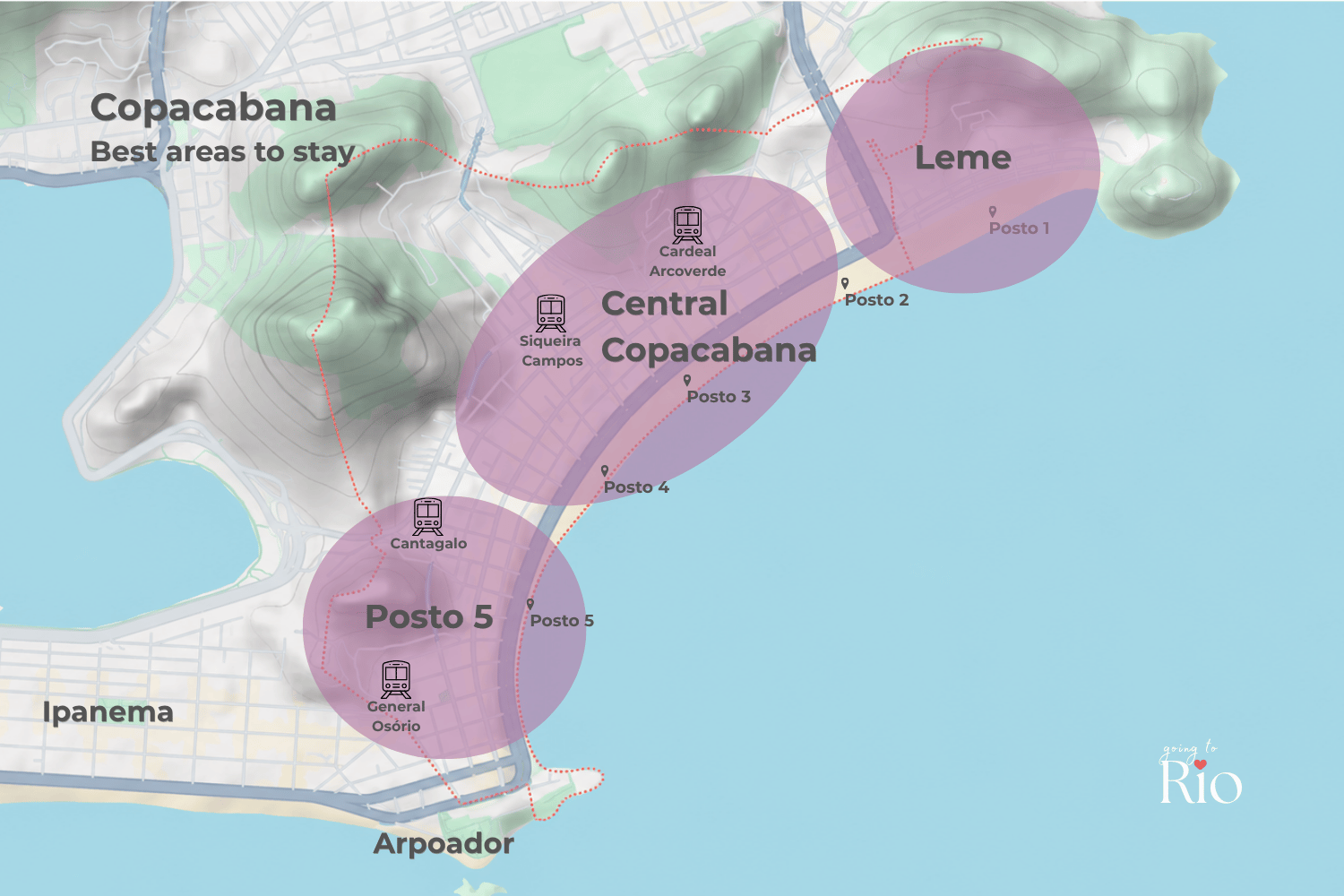
Illustrated map of Copacabana Beach showing the best areas to stay.
Leme
Best for: families, quieter evenings, and travelers who want a more residential side of Copacabana.
Leme is Copacabana at a slower pace. While still steps from the beach, its streets are quieter, the atmosphere feels more local, and the crowds are noticeably smaller than in central Copacabana.
Beyond the beach, Leme is home to one of my favorite restaurants in Rio and offers easy access to attractions like the Mureta do Leme and the scenic trail to Morro do Leme and Forte Duque de Caxias. It's also the most convenient part of Copacabana if you plan to spend time exploring Urca, Botafogo, and Flamengo.
If you're coming for one of Copacabana's big beach concerts, Leme is also the best base. I cover this in more detail in where to stay for Copacabana beach concerts. It's a solid choice for Carnival too, thanks to the blocos, though you'll be a bit farther from the metro than if you stayed in central Copacabana.
Hotel rooms & accommodation in Leme
⭐⭐⭐⭐⭐ Hilton Copacabana · From $220/night
Beachfront hotel with excellent facilities in the quieter Leme end of Copacabana.
⭐⭐⭐⭐ Novotel Rio Leme · From $150/night
Modern hotel with a rooftop pool overlooking Leme Beach.
⭐⭐⭐⭐ Windsor Leme Hotel · From $120/night
Classic oceanfront hotel with spacious rooms in a quiet location.
Central Copacabana (Postos 3–4)
Best for: first-time visitors, nightlife, and travelers who want the widest choice of hotels and restaurants.
This is the liveliest part of Copacabana and where you'll find the highest concentration of hotels, restaurants, bars, and shops. The beach is busy all day long, creating the vibrant atmosphere many visitors picture when they think of Rio.
This stretch is also where you'll find Praça do Lido, one of the official departure point for the van to Christ the Redeemer.
The trade-off is that it's also the busiest stretch of the neighborhood. Expect more traffic, larger crowds, and a noisier environment than Leme or Posto 5. As in any busy tourist area, petty theft is more common here, so staying aware of your surroundings is important.
Hotel rooms & accommodation Central Copacabana
⭐⭐⭐⭐⭐ JW Marriot Rio de Janeiro · From $320/night
Beachfront Marriott luxury with a prime location in the heart of Copacabana.
⭐⭐⭐⭐ Pestana Rio Atlantica · From $200/night
Excellent rooftop views near Posto 4.
⭐⭐⭐⭐ Hotel Astoria Palace · From $100/night.
Read my full hotel review.
Posto 5 and the Ipanema border
Best for: first-time visitors, beach lovers, and travelers who want the best of both neighborhoods.
This is my favorite part of Copacabana and the area I'd recommend to most visitors. Sitting between Copacabana and Ipanema, it gives you easy access to two of Rio's best neighborhoods while offering a noticeably more relaxed atmosphere than the central stretch.
The beach here is usually calmer thanks to the protection of Forte de Copacabana, making it a good place for swimming. The views of Sugarloaf Mountain are spectacular, and you're within walking distance of Arpoador and Ipanema Beach. The area also tends to feel more comfortable for visitors, with plenty of hotels, constant foot traffic, and a visible police presence.
Hotel rooms & accommodation near Posto 5, Copacabana
⭐⭐⭐⭐⭐ Emiliano Rio · From $520/night
Sophisticated boutique luxury with contemporary design and exceptional rooftop.
⭐⭐⭐⭐⭐ Fairmont Rio de Janeiro Copacabana · From $350/night (our top Premium pick — see above)
⭐⭐⭐⭐ Othon Palace Copacabana · From $150/night
Classic beachfront hotel with panoramic views and a prime Posto 5 location.
⭐⭐⭐ B&B HOTEL Rio Copacabana Forte · From $90/night
Excellent budget-friendly stay just a few blocks from the beach and an easy walk to Ipanema.
Vacation rentals in Copacabana
Copacabana has one of the largest selections of apartment-style accommodation in Rio de Janeiro, ranging from compact studios to spacious beachfront apartments, with options across almost every price range.
As with hotels, location makes a big difference. Apartments closer to the beach tend to cost more but offer a better overall experience. Properties farther inland are often more affordable, but it's worth checking the exact street before booking as some parts of Copacabana border hillside communities that may feel less comfortable for first-time visitors unfamiliar with the neighborhood.
You'll also notice that many apartments are in older residential buildings. While some have been beautifully renovated, others still have dated interiors. Before booking, read recent guest reviews carefully and look closely at the photos to make sure the apartment matches your expectations.
If you're staying in one of these apartments but still want a taste of Copacabana's five-star hotels, a hotel day use gets you a few hours at the pool, the spa, or the beachfront terrace, no overnight stay required.
Plan your trip to Rio de Janeiro
Now that you've decided where to stay in Copacabana, these guides will help you plan the rest of your trip.
🗺️ Best things to do in Rio de Janeiro
Find out the best places and experiences to make the most of your time in the city.
👕 What to pack for Rio de Janeiro
A packing guide, including beach essentials and what locals actually wear.
🍽️ Common travel mistakes in Rio de Janeiro
Learn how to avoid them.
How to get to Copacabana from the airport
From Santos Dumont (SDU): 20–30 minutes
From Galeão (GIG): 40–60 minutes, depending on traffic
From Novo Rio Bus Station: 25–40 minutes by Uber or taxi. Public transportation is also an option: take the VLT to Cinelândia or Carioca and transfer to the metro.
If you prefer public transportation or want a full comparison between Uber, taxis, metro, and the VLT, check out our complete guide to arriving in Rio.
How to get around Rio from Copacabana
Copacabana is served by three metro stations, Cardeal Arcoverde, Siqueira Campos, and Cantagalo. If you're staying near Posto 6, General Osório Station in Ipanema is also within walking distance, making Copacabana one of the best-connected neighborhoods in Rio.
Christ the Redeemer: Official vans depart directly from Praça do Lido, near Posto 2, about 15 minutes on foot if you're staying around Posto 5, making this one of the easiest neighborhoods for visiting the attraction.
Sugarloaf Mountain: Around 15–20 minutes by Uber to Urca. Public buses also connect the two neighborhoods.
Historic Downtown: Around 20–30 minutes by metro.
Ipanema and Leblon: Walk, cycle along the beachfront bike path, or take the metro for one stop.
New to Rio's metro, buses, bike-sharing system, or ride-hailing apps? Our complete guide to getting around Rio covers tickets, payment methods, and the easiest ways to explore the city.
What to do in Copacabana
Copacabana is not just where you stay. It becomes part of your Rio experience.
MIS — Museu da Imagem e do Som
The MIS just opened on Avenida Atlântica after nearly 20 years of construction. The building hosts immersive exhibitions dedicated to Brazilian music, Carmen Miranda, and carioca culture, along with a great coffee shop and views of the beach. The full museum experience is expected when construction completes in early 2027. Check fmis.rj.gov.br for current visiting hours and exhibitions.
Copacabana Fort
A historic fort at the far end of the beach with panoramic ocean views, a small military museum, and a great place for breakfast and brunch in Copacabana. A good stop if you want a mix of history and scenery.
Duque de Caxias Fort (Morro do Leme)
At the opposite end of the beach, this fort sits at the base of a short hiking trail offering sweeping views of the entire Copacabana beach and Sugarloaf Mountain. Best visited in the late afternoon for the light.
Mureta do Leme
A low-key spot that most visitors miss. The seawall at Leme offers one of the best views of Copacabana beach and the sunset, with informal vendors selling coconut water and caipirinhas right on the wall. No entrance fee, no reservations needed.
Samba at Bip Bip
A tiny bar on Rua Almirante Gonçalves that has become one of the most authentic samba experiences in Rio. No stage, no tickets, no tourists-only vibe, just musicians playing in and around a small corner bar, most nights of the week. Arrive early and stay late.
Blue Note Rio
For jazz and bossa nova in a more refined setting, Blue Note Rio is the address. A great option for a night out, with international and Brazilian acts. Worth booking in advance.
Roxy Dinner Show
A classic Rio dinner show experience with live music, Brazilian cuisine, and a theatrical production in one evening. A good option for travelers who want a structured cultural night out.
Rooftop bars
Several hotels along Avenida Atlântica have rooftop bars open to non-guests. The views over the beach are worth the drink prices.
Where should you stay in Copacabana?
Few neighborhoods in Rio are as democratic as Copacabana. Budget hostels and iconic luxury hotels share the same streets and the same sunrise, all just steps from its famous beach. Whatever your budget, you'll enjoy the same beachfront lifestyle, with three metro stations, a huge choice of restaurants, and easy access to the rest of the city.
It's also the best base if you're visiting during New Year's Eve, Carnival, or one of Copacabana's famous beach concerts, when Rio's biggest celebrations happen right outside your door. For those moments, I wrote detailed guides:
🎆 Where to stay in Rio de Janeiro for New Year’s Eve
🎭 Where to stay in Rio de Janeiro during Carnival
🎤 Where to stay for Copacabana Beach concerts
And if Copacabana doesn't sound like the right fit for your trip, our complete guide to where to stay in Rio de Janeiro breaks down every neighborhood so you can compare and find the one that matches you.
FAQ - Where to stay in Copacabana
Is Copacabana safe?
Yes. Copacabana is generally safe for tourists, especially if you stay near the beach or close to a metro station. It's heavily policed with a constant security presence along Avenida Atlântica and the main commercial streets.
Choosing the right part of the neighborhood makes a difference. Leme and Posto 6 generally feel calmer than central Copacabana. For a complete guide to staying safe in Rio see our safety guide for Rio de Janeiro.
Is Copacabana right for first-time visitors?
Yes. Copacabana is one of the best neighborhoods for a first trip to Rio. It combines an iconic beach, excellent public transportation, a huge range of hotels, and easy access to the city's main attractions.
Should I stay in Copacabana during Carnival or New Year's Eve?
Absolutely. If you're visiting for Carnival, New Year's Eve, or one of the major concerts on Copacabana Beach, staying here means you can walk to the events and avoid traffic, surge pricing, and long journeys back late at night.
Is Copacabana good for budget travelers?
Copacabana has the widest range of accommodation in Rio, from hostels and simple hotels to beachfront luxury properties. It's one of the easiest places to find good value without sacrificing location.
Is Copacabana too touristy?
Copacabana is Rio's most visited neighborhood, and it certainly feels that way. If you're looking for a more local atmosphere, consider staying in Botafogo, Santa Teresa, or even Ipanema instead.
Is Copacabana LGBT-friendly?
Yes. Copacabana is one of Rio's most LGBT-friendly neighborhoods, particularly around Postos 5 and 6, where you'll find an inclusive atmosphere and easy access to Ipanema's LGBT+ beach scene.

Written by Karina
Born and raised in Rio de Janeiro, Karina spent over a decade working in the tourism industry, with experience in some of the world's leading travel destinations. She created Going to Rio to bring that same standard of practical, traveler-first guidance to visitors exploring Rio de Janeiro. Learn more about Karina



Beachfront hotels in Copacabana can cost up to $900 a night. I stayed at the cheapest one with ocean view for $109, and I'm sharing exactly what it's like.