

Copacabana Beach is probably the most famous beach in Brazil, and its fame extends to the whole neighborhood around it. There’s the iconic black-and-white wave-patterned promenade, the legendary Copacabana Palace, and that long, wide stretch of golden sand.
But Copacabana Beach in Rio de Janeiro is much more than a place to sunbathe. It’s an outdoor stage and a sports court all in one, the setting for sunset walks, and home to massive events like free concerts and the biggest New Year’s Eve party in the world.
For many people planning a trip to Rio de Janeiro, Copacabana Beach is the first place that comes to mind, and also the source of many questions. Is the beach actually good? Which part should I go to? Is it safe to swim? Is it too crowded? What should I bring?
I was born and raised in Rio, and over time, I’ve found my favorite stretch for swim, sunbath and sunrise, and picked up the little tricks that make a beach day here so much better.
This guide covers everything you need to know about Copacabana Beach: how the postos work, which part to choose, where to swim safely, what to bring, and the events that made it world-famous.

Copacabana Beach for first-timers: how it all works
To me, Copacabana Beach is the place that best captures Rio’s way of life. The moment you step onto the sand, you understand that for us, the beach and the promenade are one big public living room, a space for leisure where every crowd and every tribe has its place. And in Copacabana, that place usually has a number: the posto.
Understanding Copacabana Beach postos
Copacabana Beach is long, about 4 kilometers of sand, so the first thing you need to learn is how locals find their way around it: the postos.
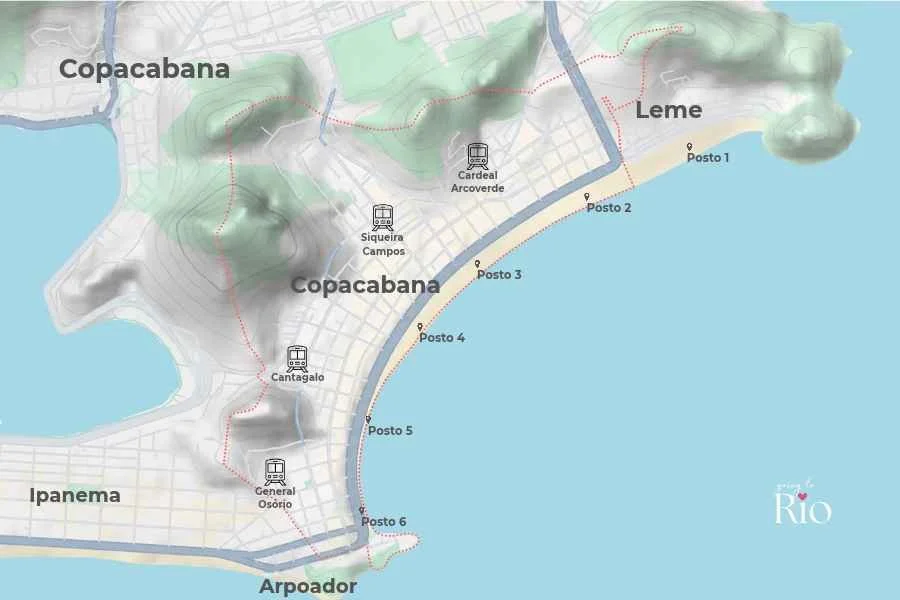
The postos are the lifeguard stations spread along the beach, from Posto 1 in Leme to Posto 6 by Copacabana Fort, at the border with Ipanema. Designed in the 1970s, they’re a small piece of Brazilian modernist architecture, built to blend into the landscape rather than compete with it. And they’re useful, too, with public restrooms, an observation deck, and a first-aid station.
But for us, postos are much more than lifeguard towers. They’re how we give directions, set meeting points, and even describe people. “Meet me at Posto 5” is a perfectly normal plan in Rio, and once you spend a few days here, you’ll notice that each stretch has its own crowd and personality.
Which part of Copacabana Beach to choose (and where to swim)
If you’re traveling with kids or just want a calmer swim, head to either end of the beach. Between Postos 1 and 2 near Hilton Copacabana, and again between Postos 5 and 6 around Fairmont and Othon Palace hotels, the strip of sand gets narrower and the waves get gentler, which is why families love these stretches.
In the middle, between Postos 2 and 4, the energy changes. This is the sporty, busy heart of Copacabana, packed with volleyball and footvolley courts, where you can spend an afternoon just watching games.
As for me, I always end up between Postos 5 and 6, in front of Hotel Emiliano. The water is calmer, the sand is less crowded, and there’s the view: Sugarloaf Mountain, perfectly framed at the other end of the bay. It’s the spot to spend a whole day or start early with a surnise stand up paddle session.
That said, water safety is taken very seriously in Rio. These are open-ocean beaches, so being a confident swimmer with experience in the sea is essential. Lifeguards use a flag system along the beach to signal conditions in each stretch, and the most important rule is simple: follow it. A calm-looking sea can hide strong currents, so let the flags guide you, not the surface of the water.
If you’re looking for the calmest spots for a swim, I’ve listed them in my guide to Rio de Janeiro’s beaches, and my guide to Rio’s beach culture covers the other unwritten rules worth knowing before your first beach day.

Copacabana Beach services
Here’s something that surprises almost every first-timer: you barely need to bring anything to the beach. Chairs and umbrellas for rent, cold drinks, snacks, hats, sarongs, even swimwear, all sold by vendors who spend the whole day walking the sand under the sun so you never have to leave your spot.
Chairs and umbrellas are rented by the day, but if you arrive in the afternoon, don’t be shy about asking for a half-day price. It’s common practice. And if you need to leave for lunch or run an errand, just let the vendor know. They’ll keep your chair waiting for you, as they always do for me.
Curious about what to eat? I’ve covered the classic beach snacks, from grilled cheese on a stick to ice-cold mate, in my guide to food in Rio de Janeiro.
Copacabana Beach promenade
Copacabana’s promenade, famous for its black-and-white wave-patterned sidewalk, is more than a way to get from one end of the beach to the other. It’s an attraction in its own right.
This is where the kiosks are, open all day long, serving everything from breakfast with an ocean view to live samba in the evening. It’s also where locals walk their dogs, go for a run, or ride along the bike path that runs the length of the beach. On Sundays and public holidays, the beachside lanes of Avenida Atlântica close to cars, and the whole waterfront turns into one giant open-air space for walking, cycling, and people-watching.
Start your day with breakfast at one of my favorite kiosks, in my guide to the best breakfast and cafés in Copacabana, and end it with live samba at another, featured in my guide on where to see live samba in Rio.

The statues along the promenade
Walking the promenade, keep an eye out for a few familiar faces. Copacabana pays tribute to some of the Brazilian artists who lived here or sang about it, with life-size bronze statues you can sit next to. Spotting all three makes a great walk along the promenade, one of my favorite things to do in Copacabana.
At Posto 5, poet Carlos Drummond de Andrade, who lived in Copacabana for decades, sits on a bench with his back to the sea. His bronze glasses have been stolen so many times that replacing them has become a running joke in the city.
In Leme, at the quieter end of the beach, writer Clarice Lispector, one of Brazil’s greatest authors, is portrayed with her dog Ulisses. She lived in Leme, and the statue is a lovely stop on a walk toward Mureta do Leme.
And at Posto 6, singer and composer Dorival Caymmi, whose songs celebrated the sea and Brazilian beach life, stands as a tribute to the music that helped put Brazil’s coast on the map.



What to wear (and bring) at the beach
On Rio’s beaches, the basic kit is simple: swimwear, flip-flops, a canga (the colorful sarong you’ll see everywhere on the sand, which locals use instead of a towel), and a cover-up, or any light outfit that does the job for the walk to and from the beach.
If you’re coming from abroad, you might find Brazilian bikinis on the small side. In general, they are smaller, but that doesn’t mean you need to wear one. The best choice is whatever makes you feel comfortable. As for men, both swim briefs and swim shorts are common.
One thing to know: neither topless sunbathing nor nudity is accepted on Rio’s beaches, including Copacabana. The city has a single naturist beach, Praia do Abricó, and even there, nudity is only allowed on weekends.
As for what to bring, keep it simple: sunscreen, sunglasses, a hat, your phone, and some cash in small bills for chairs and snacks. Many beach vendors also accept Pix, Brazil’s instant payment system, and as a visitor, you can use it too. I explain how in my guide to Pix in Brazil for foreigners.
Leave your passport, jewelry, and anything you’d hate to lose at your hotel. With vendors selling everything from water to grilled cheese, you won’t need to pack food or drinks.
For more on how to dress like a local, from the beach to a night out, see my guide on what to wear in Rio de Janeiro.
Events on Copacabana Beach
This is where Copacabana Beach truly shines. As I said at the beginning, the beach is Rio’s great public space for leisure, and for Brazilians, leisure usually comes with music.
Over the years, Copacabana has become one of the most famous event stages in the world, a story I tell in my article on how Copacabana Beach became the world’s biggest event stage. For locals, Avenida Atlântica and the promenade are also where the city gathers to celebrate, protest, and express its faith.
On the sand, you’ll find beach sports championships like footvolley, fan fests with giant screens for events like the World Cup and Carnival, and, above all, the biggest party of them all: New Year’s Eve in Copacabana.
In recent years, the free mega concerts held every May have also turned Copacabana into one of the top travel destinations of the month, and a new mega show was recently announced for November 2027, with Calvin Harris as the headliner.
Along the promenade, Rio Pride, Carnival blocos (Rio’s famous free street parties) and samba school parades are among the most popular celebrations.
These events completely change how the neighborhood works, with closed streets, huge crowds, and heavy demand for hotels, so where you stay makes a difference. I’ve been in Copacabana for all of them, and wrote guides to help you decide where to stay for New Year’s Eve in Rio, where to stay for the Copacabana Beach concerts, and where to stay for Carnival.


Is Copacabana Beach safe?
Yes, Copacabana Beach is generally safe, as long as you take the same precautions you would in any big city. It’s one of the busiest beaches in Rio, popular with both locals and tourists, and like every area where visitors gather, it has a constant police presence. In summer, when crowds grow, that presence is reinforced even further.
Most problems here are crimes of opportunity, like pickpocketing and petty theft, and they’re easy to avoid with a few simple habits. I use my phone on the sand without any problem, but I avoid scrolling while walking along the promenade or crossing the street, which is exactly when distracted people become easy targets.
If you’re at the beach alone, it’s common practice to ask someone sitting nearby to keep an eye on your things while you go for a swim. I always choose a spot near women or families, partly with this in mind.
One rule I’d never break: stay off the sand after dark. The beach is less lit and less patrolled at night, and swimming at night isn’t something locals do in Copacabana. If you really want a night by the sea, nearby Arpoador has lighting after dark.
Watching the sunrise from Copacabana Beach is beautiful and well worth waking up for, but it does call for a few precautions, which I explain in my guide to the best spots to watch the sunrise in Rio.
Explore more of Copacabana
The beach is just the beginning. If you’re planning your time in Copacabana, these guides will help you with everything from choosing where to stay to finding the best places to eat and making the most of the neighborhood’s biggest events.
Where to Stay in Copacabana
The best areas of the neighborhood with my hotel picks for every budget.
The Cheapest Beachfront Hotel in Copacabana
My honest review of an ocean-view stay that won’t break the bank.
16 Things to Do in Copacabana
From historic forts and sunset spots to live samba at night.
Best Breakfast and Cafés in Copacabana
My 9 local favorites, from beach kiosks to neighborhood bakeries.
Best Restaurants in Copacabana
My favorite places, from braseiros to rooftop bars.
Copacabana Beach Concerts
Everything about the free mega shows on the sand, from dates to tips for the big day.
New Year’s Eve in Copacabana
How to experience the world’s biggest New Year’s party, from fireworks to what to wear.
Rio Pride in Copacabana
What to expect from one of the biggest Pride celebrations in Brazil.
How to Get from Rio Airport to Copacabana
All your transport options from the airport, with prices and tips.
Rio de Janeiro Metro Stations
How the metro works and which stations to use in Copacabana and beyond.
How to Get to Christ the Redeemer
All the ways to reach the statue, including the official vans from Copacabana.
Copacabana Beach, Rio de Janeiro - FAQ
Is Copacabana a nudist beach?
No. Nudity and topless sunbathing aren’t accepted on Copacabana Beach or on any other beach in Rio, except Praia do Abricó, the city’s only naturist beach.
Is Copacabana in Rio de Janeiro?
Yes. Copacabana is a neighborhood in Rio de Janeiro’s South Zone, between Leme and Ipanema. Its beach is the most famous in the city, which is why many people think of it as a destination of its own.
Is it safe to swim at Copacabana Beach?
Yes, as long as you’re a confident swimmer and follow the lifeguards’ flags. Copacabana is an open-ocean beach, and a calm-looking sea can hide strong currents. The calmest stretches are at either end of the beach, between Postos 1 and 2 and between Postos 5 and 6.
Which is better, Copacabana or Ipanema beach?
It depends on what you’re looking for. Copacabana is bigger, more diverse, and the stage for Rio’s biggest events, with a lively, down-to-earth feel. Ipanema is more upscale and trendy, with a younger crowd and the famous sunset at Arpoador. Both are great beaches, and they’re right next to each other, so you can easily enjoy both.
What is the best time to visit Copacabana Beach?
Copacabana is a year-round beach. Summer, from December to March, is peak season, with the hottest weather, the biggest crowds, and the biggest events. But don’t overlook winter: from June to August, Rio stays warm enough for the beach, with plenty of sunny days and less rain than in summer. For many locals, including me, it’s one of the best times of year to enjoy the beach without the summer crowds. I break it down month by month in my guide to the best time to visit Rio de Janeiro.
How far is Copacabana from the airport?
Copacabana is about 30 kms from Rio’s international airport (GIG), a trip that usually takes 35 minutes, depending on traffic. I cover all your options in my guide on how to get from the airport to Copacabana.

Written by Karina
Born and raised in Rio de Janeiro, Karina spent over a decade working in the tourism industry, with experience in some of the world's leading travel destinations. She created Going to Rio to bring that same standard of practical, traveler-first guidance to visitors exploring Rio de Janeiro. Learn more about Karina



Want to know if Copacabana Beach is safe, good for swimming, and what to wear and bring? Here are all the answers from a Rio native.